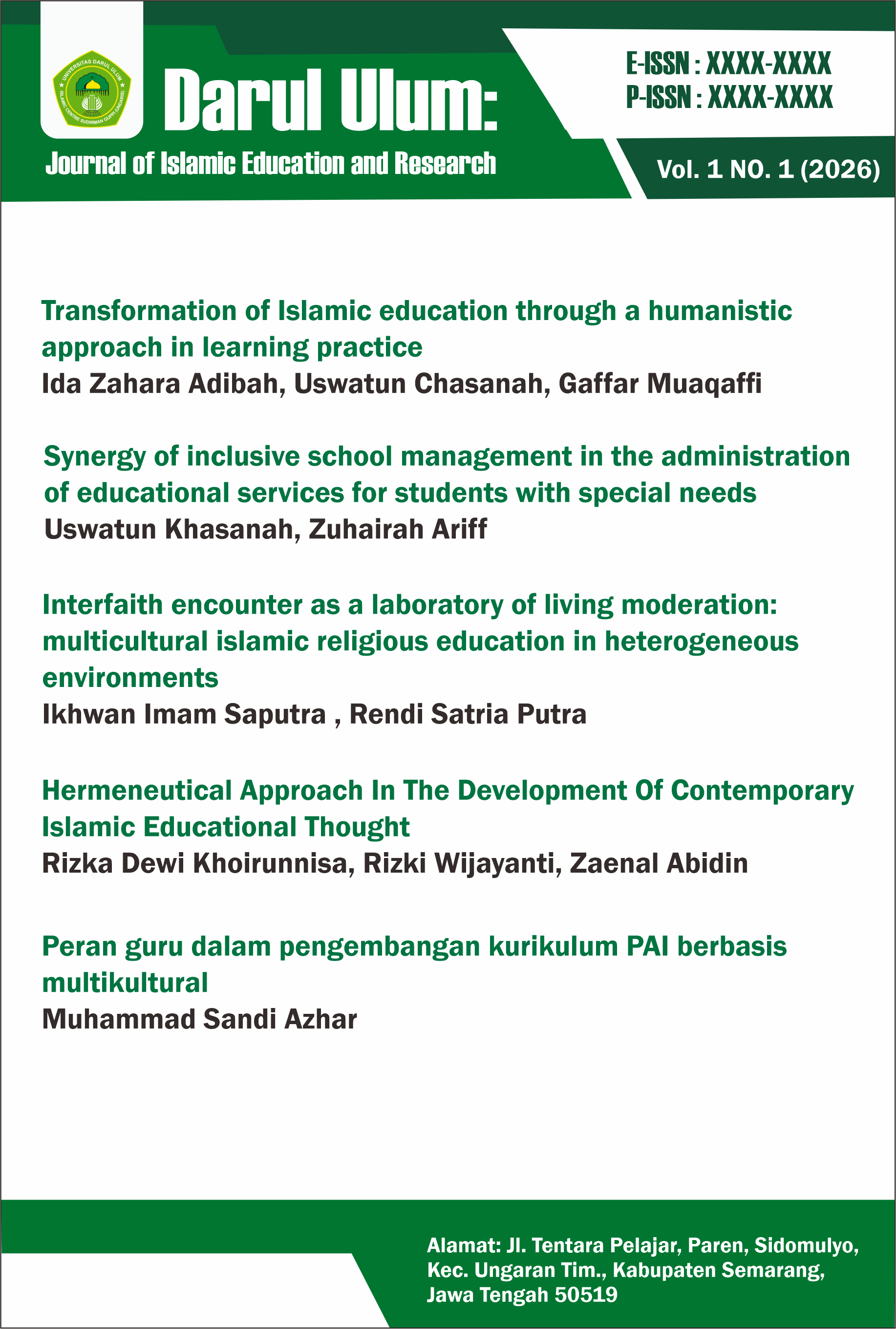
This issue features contributions from authors representing five countries: Indonesia, Australia, Malaysia, Egypt, and Sudan. The diversity of the authors' national backgrounds reflects the strength of cross-country academic collaboration in addressing contemporary educational, social, and religious challenges. Most articles focus on issues related to Islamic education and the development of educational human resources, including the transformation of Islamic Religious Education (PAI) learning through a humanistic approach, co-authored by researchers from Universitas Darul Ulum Semarang together with an academic from The University of Melbourne, Australia; the synergy of inclusive school management for students with special needs, co-authored with a researcher from University Sultan Zainal Abidin, Malaysia; and a hermeneutical approach to the development of contemporary Islamic educational thought.
In addition, several articles examine the teacher's role in developing a multicultural-based PAI curriculum, the role of PAI teachers in shaping students' mental health in the digital era, and strategies for increasing learning motivation in Islamic educational psychology, written by cross-institutional teams including Al-Azhar University in Cairo (Egypt) and the University of the Holy Quran and Islamic Sciences in Omdurman (Sudan). Beyond curriculum and motivation-related themes, this issue also highlights religious moderation through an article on interfaith encounter as a laboratory of living moderation within multicultural Islamic religious education in a heterogeneous environment, a collaborative work between authors from Darul Amanah Bedono Islamic Boarding School, Semarang, and Al-Azhar University, Cairo. Overall, this collection of articles reflects a growing research orientation toward strengthening Islamic and cultural values, international academic collaboration, the transformation of Islamic education curricula, and the formation of character and mental health among young Muslims amid the challenges of the digital era and multicultural society.
Published: 2026-07-01